
Massage Chair Wholesale: How to Buy in Bulk Without Buying the Wrong Problem
Deciding Which to Stock?
We carry both massage sofas and massage chairs — get wholesale pricing and expert advice on which moves faster in your market.
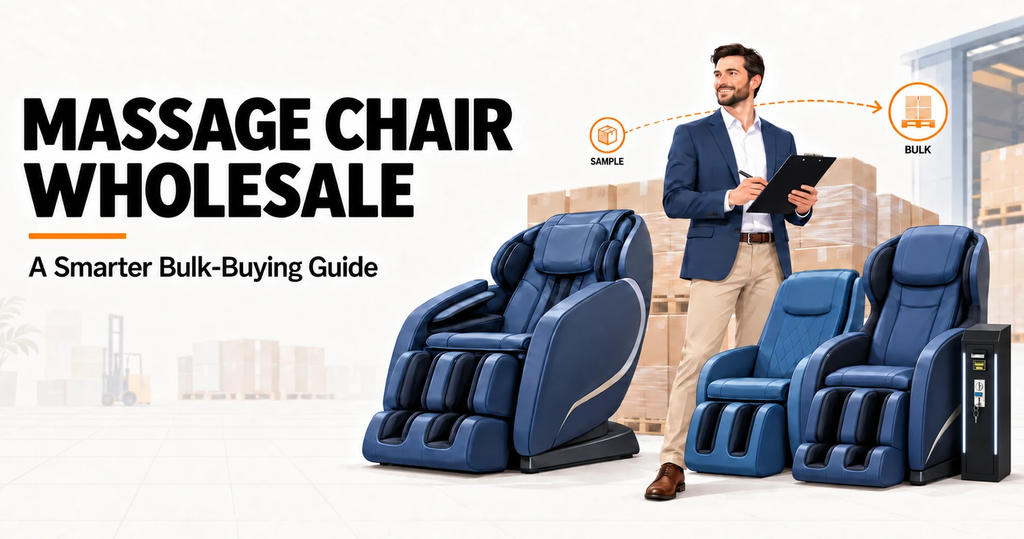
Ordering massage chairs wholesale can look wonderfully simple on a spreadsheet. Pick a model, multiply the unit price, book a container, and wait for the cartons.
Then reality arrives—sometimes in the same container.
A chair may look excellent in a showroom yet be awkward to assemble, expensive to service, poorly matched to local buyers, or packed in a way that turns freight into an unpleasant surprise. In wholesale, the cheapest quotation is not always the lowest-cost decision.
This guide explains how brands, distributors, retailers, and OEM buyers can evaluate a massage chair wholesale program from sample to scale.

Start with the market, not the feature list
Before comparing 3D, 4D, zero gravity, heating, voice control, or the number of automatic programs, answer a more useful question: who will use the chair, and where will it be sold?
A premium chair for a specialist wellness showroom has a different job from a compact model sold online. A commercial chair in an airport, shopping mall, or hotel needs a different payment, enclosure, and maintenance plan from a home-use chair.
Your first sourcing brief should cover
- target country and sales channel;
- expected retail price range;
- home, retail, hospitality, or pay-per-use application;
- preferred size, appearance, and key functions;
- local voltage, plug, language, and certification needs;
- initial test quantity and expected scale-up quantity.
That one-page brief is far more valuable than sending a supplier a message that says, “Please quote your best massage chair.” Without context, “best” usually means “the model the supplier wants to sell today.”
Choose a product mix that has a reason to exist
Wholesale buyers can source several broad product types:
| Product type | Best suited to | Questions to ask |
| Full-body massage chair | Wellness brands, specialist retailers, premium e-commerce | Which mechanism, track, body-scan method, heating zones, and user sizes does it support? |
| Commercial or vending chair | Malls, airports, hotels, waiting areas | Which payment methods are available? How are earnings, access, and daily cleaning managed? |
| Compact massage chair | Furniture stores, apartments, online retail | What is sacrificed to reduce size, and is delivery easier? |
| Massage sofa | Living-room and furniture channels | Does it still look and sit like furniture when massage is off? |
| Portable massager | Entry-level, gift, travel, or add-on sales | Is the product clearly differentiated, easy to demonstrate, and economical to ship? |
Avoid building a first order from five products that all chase the same customer. A useful mixed shipment tests different price points or use cases.
For example, a distributor might compare one premium full-body model, one mid-range volume model, and one compact model—not three chairs whose only obvious difference is the remote control.
Compare landed value, not only FOB price
The factory price is important. It is also only the beginning.
The real commercial question is:
What will each sale cost after freight, duty, storage, assembly, customer support, spare parts, and warranty service?
A slightly lower FOB price can disappear quickly if the carton wastes container space, the chair arrives in too many pieces, or common repairs require shipping an entire assembly instead of a replaceable part.
When comparing quotations, ask for the same information from every supplier
- packed dimensions, gross weight, and loading quantity;
- assembly steps and estimated assembly time;
- included spare parts and recommended spare-parts list;
- warranty scope and exclusions;
- diagnostic support and replacement-part process;
- packaging options for retail, e-commerce, or bulk distribution;
- Incoterm and port of shipment.
This turns a price comparison into a business comparison.
FOB, CIF and the other delivery terms in a quotation split cost and risk at different points, defined under the ICC Incoterms 2020 rules — confirm which delivery term each supplier assumes before you compare prices.

Use samples to test the whole experience
A sample is not a miniature bulk order. It is a test of the product and the supplier.
Do not only sit in the chair for ten minutes. Follow the same journey your future customer and service team will experience:
- Inspect the carton and internal protection.
- Record the unboxing and assembly process.
- Test the chair with users of different heights and body shapes.
- Run every program, manual control, heating zone, airbag, recline function, and safety stop.
- Check noise, upholstery fit, seams, cables, connectors, and moving gaps.
- Ask the supplier one realistic technical question and evaluate the clarity of the response.
- If possible, repeat use over several days instead of judging a single showroom session.
The sample should also match the intended production configuration. Confirm any differences in upholstery, electronics, language, logo, plug, packaging, or software before approving it.

MOQ flexibility is useful—when the order remains manageable
A mixed-model trial can reduce inventory risk in a wholesale massage chair program, especially when entering a new category. It lets a buyer learn which appearance, price point, and feature combination actually sells before committing to a full container of one SKU.
But variety has a cost. Every extra model means another manual, spare-parts list, set of product photos, support script, and stock record. A first order with too many SKUs can create a small museum in the warehouse.
A sensible trial order keeps the comparison focused. Agree in writing on:
- minimum quantity per model and total order quantity;
- whether sample costs or setup charges can be credited later;
- which colors and functions may be mixed;
- whether packaging and branding are standard or customized;
- the production lead time for the final confirmed mix.
Treat OEM branding as a system, not a logo
Private label often begins with a logo request, but the customer sees much more than the badge on the chair.
A complete massage chair sourcing checklist may include:
- chair color, upholstery, stitching, and trim;
- logo placement on the chair and controller;
- user-interface language and voice language;
- automatic program names and timer settings;
- rating label, plug, voltage, and printed warnings;
- manual, carton artwork, product photography, and barcode labels;
- spare-parts identification and after-sales documents.
Ask which changes are cosmetic, which require engineering work, and which trigger new tooling, testing, certification, or MOQ requirements. Confirm all approved details in a signed specification sheet. “Same as the sample, but with our brand” leaves too much room for interpretation.
Ask for evidence behind quality claims
Nearly every factory says it has strict quality control. Useful suppliers can explain what is inspected, when it is inspected, how results are recorded, and what happens when a unit fails.
Relevant evidence for a massage chair includes
- incoming inspection for upholstery, motors, electronic parts, frames, and hardware;
- in-process checks for wiring, connectors, fasteners, alignment, and moving clearance;
- functional testing of massage, airbags, heating, recline, controls, and safety protection;
- electrical safety checks appropriate to the product and destination market;
- finished-product inspection and packaging checks;
- traceability for production batches and key components.
Certification deserves the same discipline. Ask for documents that cover the exact model and intended market, then confirm whether any customization changes the certified configuration. A certificate shown in a brochure is not automatically evidence for every product in a catalog.

Plan after-sales before the first sale
The moment to design after-sales support is before the purchase order—not after a customer sends a video of a chair that “makes a strange sound somewhere near the back.”
The after-sales checklist to settle before the PO
- warranty period by component;
- remote diagnosis procedure;
- response time and technical contact;
- parts supplied with the order;
- availability and price of future spare parts;
- repair videos, exploded diagrams, wiring information, and error-code guidance;
- how approved warranty claims are credited or replaced.
Modular parts, clear connectors, useful diagnostic information, and responsive engineering support can reduce the cost of a service case. The goal is not to pretend failures never happen. It is to make the occasional problem faster and less expensive to solve.
A practical wholesale process
A clear project usually follows six stages
- Brief: Share the market, channel, budget, required functions, quantity, and compliance needs.
- Shortlist: Compare a small number of models against the same criteria.
- Sample: Test product performance, packaging, documentation, and supplier response.
- Specification: Freeze the model, components, software, appearance, labels, and packaging.
- Production and inspection: Agree on lead time, quality checkpoints, inspection method, and shipping documents.
- Launch and review: Track sales, returns, service questions, and customer feedback before scaling.
This process is less dramatic than buying from a catalog in one afternoon. It is also much more likely to produce a second order.
Questions to send with your first inquiry
To receive a useful quotation, include
- destination country;
- buyer type and sales channel;
- models or target retail segment;
- trial and forecast quantities;
- essential functions;
- voltage, plug, and language;
- branding and packaging requirements;
- required compliance documents;
- target delivery date and preferred Incoterm.
The supplier should then be able to respond with a relevant model recommendation, MOQ structure, quotation, packed dimensions, lead time, customization scope, and sample plan.
Build the order around what happens after arrival
Good wholesale sourcing is not about finding the chair with the longest feature list. It is about building a product offer that fits the market, survives delivery, is easy to support, and leaves room for sustainable margin.
Fujian Sweet Home works with brands, distributors, retailers, and OEM buyers on home-use, compact, and commercial massage chair projects.
If you are planning a trial order or reviewing your current range, send us your target market, channel, quantity, and must-have functions through our contact page. We can help narrow the shortlist before you spend time comparing models that were never a good fit.
Related Reading
- Wholesale Massage Chair Bulk Order Business Solution
- Commercial Massage Chair Wholesale Price: Complete 2026 B2B Buying Guide
- How to Choose a Reliable Massage Chair Manufacturer for B2B Bulk Procurement
Deciding Which to Stock?
We carry both massage sofas and massage chairs — get wholesale pricing and expert advice on which moves faster in your market.